
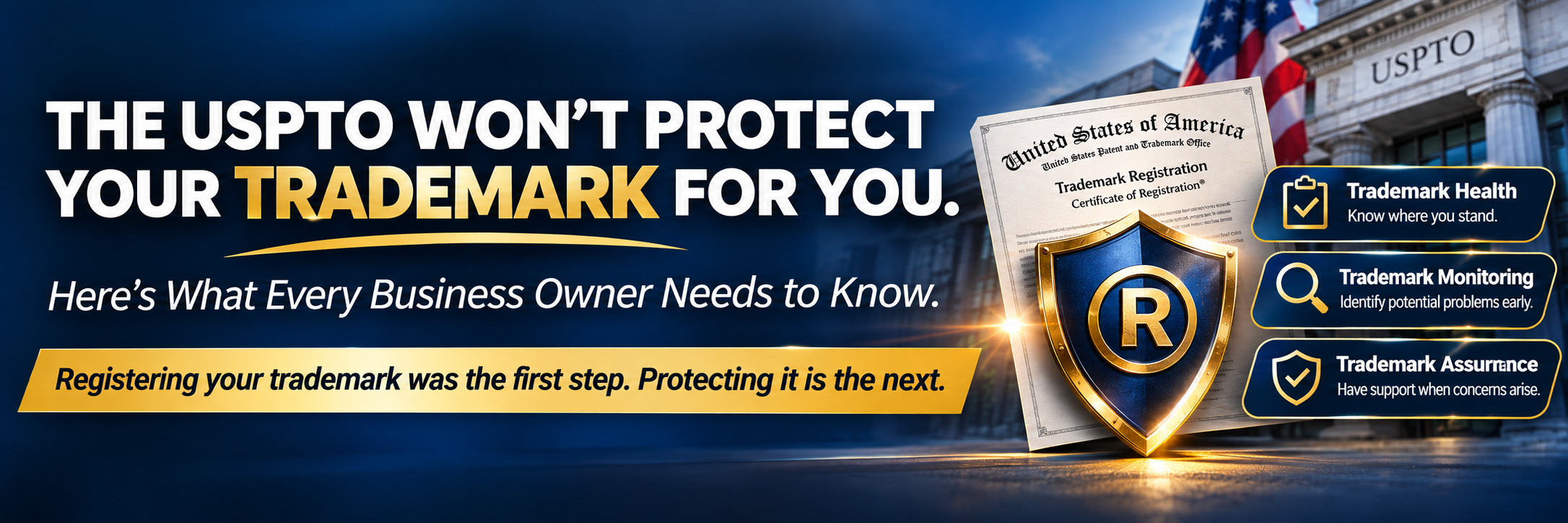
The USPTO Won't Protect Your Trademark for You. Here's What Every Business Owner Needs to Know.
Registering your trademark is only the beginning. Discover why ongoing trademark health, monitoring and assurance should be part of every entrepreneur's brand protection strategy.
Registering your trademark is one of the smartest investments you can make in your business. But assuming the government will protect it for you could be one of your most expensive mistakes.
You built a business. You developed a brand. You invested in a website, marketing, products, packaging and customer relationships.
Then you registered your trademark with the United States Patent and Trademark Office (USPTO).
Your registration certificate arrived. You started using the ® symbol. You checked another important item off your entrepreneurial to-do list.
Your brand is protected.
Or is it?
For many business owners, trademark registration creates a false sense of security. They assume that because the federal government registered their trademark, it will also watch over their brand, identify potential infringement and take action against businesses attempting to capitalize on their success.
Unfortunately, that is not how trademark protection works.
The Biggest Misconception About Trademark Registration
The USPTO plays an essential role in examining trademark applications, issuing registrations and maintaining the federal trademark register.
But the responsibility for enforcing your trademark rights belongs to you.
The USPTO's trademark process guidance explains the distinction between registering a trademark and enforcing the rights associated with it.
Think of it this way.
Purchasing a home establishes your ownership of the property. But it doesn't automatically provide you with a security system, surveillance cameras or someone watching your property when you're away.
Trademark registration works much the same way.
Registration establishes important rights. Protecting those rights requires ongoing attention.
And as your business grows, the importance of that attention grows with it.
Your Brand May Be at Risk Without You Knowing It
Imagine discovering that another business has started operating under a name remarkably similar to yours.
Perhaps it sells competing products online. Perhaps it advertises on Google using similar branding. Perhaps it has even filed its own federal trademark application.
Customers begin confusing the two businesses. Your reputation becomes intertwined with someone else's. Revenue that might otherwise have been yours begins going elsewhere.
Meanwhile, you had no idea any of this was happening.
This is one of the challenges of modern brand protection. Between e-commerce, online marketplaces, social media and AI-powered business creation tools, new brands can emerge remarkably quickly.
Your trademark may have been registered years ago.
Your next potential competitor could launch tomorrow.
Five Ways Your Registered Trademark Could Be at Risk
1. Missing an Important Maintenance Deadline
Federal trademark registrations are not permanent without maintenance.
For most U.S. trademark registrations, required maintenance filings occur between the fifth and sixth years following registration, between the ninth and tenth years, and every ten years thereafter.
Failure to submit the required filings and fees can result in the cancellation or expiration of your federal registration.
After years of investing in a brand, losing a registration because of a missed deadline can be particularly frustrating.
Learn more in the USPTO's guide to Maintaining Your Federal Trademark Registration .
2. New, Potentially Conflicting Trademark Applications
Businesses regularly file new trademark applications with the USPTO. Some may contain names, logos or other branding elements similar to yours.
While the USPTO examines applications for certain conflicts, its examination process is not a substitute for your own trademark monitoring efforts.
Identifying potentially conflicting applications early may provide opportunities to address concerns before another brand becomes established in the marketplace.
3. Unauthorized Use of Your Brand
Not every company using a potentially conflicting trademark applies for federal registration.
Some businesses simply begin using a name, logo or branding that resembles an existing brand.
This activity can occur on websites, online marketplaces, social media platforms or in physical locations.
Depending on the circumstances, such activity may create customer confusion, damage your reputation or interfere with your business's growth.
4. Outdated Trademark Ownership or Contact Information
Businesses change over time. Companies relocate. Ownership changes. LLCs become corporations. Businesses merge, acquire assets or restructure.
Yet their trademark records may not always reflect those changes.
Periodically reviewing your trademark information can help identify discrepancies and ensure that important correspondence reaches the appropriate person.
5. Changes in How You Use Your Trademark
Brands evolve. Logos are redesigned. Products are discontinued. Businesses expand into new industries. The way a trademark is used today may differ significantly from how it was used when originally registered.
These changes can have implications for your trademark portfolio.
Understanding the current condition of your trademarks can help you identify matters that may require further attention.
A Better Approach: The Three Pillars of Trademark Protection
Successful businesses routinely monitor their finances, cybersecurity, marketing performance and customer satisfaction.
Why should one of their most valuable intellectual property assets receive any less attention?
A proactive trademark protection strategy can be built around three fundamental pillars:
Health. Monitoring. Assurance.
Each serves a different purpose. Together, they provide a more comprehensive approach to managing your trademark portfolio.
Trademark Health — Know Where You Stand
When was the last time you reviewed the current status of your trademark?
Do you know your next maintenance deadline? Is your ownership information current? Are there matters associated with your registration that may require attention?
For many business owners, the answer is simply, “I'm not sure.”
That's why The Trademark Company developed its Trademark Health Report .
Our Trademark Health Reports provide business owners with an accessible overview of their enrolled trademark portfolios, including registration status, important dates, health assessments and potential concerns.
Rather than navigating government databases and attempting to interpret complex records on your own, you can receive organized information about your enrolled trademarks.
Think of it as a regular checkup for your brand.
Trademark Health helps you understand what is happening with your trademark.
Trademark Monitoring — Know What's Happening Around You
Understanding the condition of your own trademark is important. Understanding what may be happening around it is equally important.
Trademark Monitoring adds ongoing monitoring of new trademark filings to help identify potentially conflicting activity.
Monitoring subscribers receive the benefits of Trademark Health Reports along with updated reporting twice per month.
Consider the difference between discovering a potentially conflicting trademark application shortly after it is filed and discovering a competing brand several years after it has entered the marketplace.
Earlier awareness may provide more opportunities to evaluate the situation and determine what action, if any, is appropriate.
Not every similar trademark presents a legitimate conflict. But knowing about potentially relevant activity gives business owners the opportunity to investigate further.
Trademark Monitoring helps you stay informed about potential threats to your brand.
Trademark Assurance — Have Support When Concerns Arise
What happens when potentially conflicting trademark activity is identified?
For many entrepreneurs, this is where uncertainty begins. What options are available? Where can they turn for assistance? What resources will they need?
The Trademark Company's Trademark Assurance service builds upon Trademark Health and Monitoring by adding defined enforcement-related support.
Depending on the selected subscription tier and applicable terms, benefits may include:
- An annual allowance of eligible letters of protest.
- Preferred pricing on additional enforcement services.
- Dedicated customer support.
- Continued trademark health reporting and monitoring.
A letter of protest is a mechanism through which qualifying evidence may be submitted to the USPTO concerning certain grounds for refusing a pending trademark application.
It is not appropriate for every situation, and its submission does not guarantee that an application will be refused.
Nevertheless, having access to defined support when potential concerns arise can be a valuable component of a broader brand protection strategy.
Trademark Assurance helps you access additional support when potential issues arise.
Three Levels of Protection. One Important Asset.
Every business is different. A startup with one trademark may have different needs than an established company managing an extensive portfolio.
The Trademark Company offers three subscription options designed to accommodate those differences.
Trademark Health
Starting at- Trademark Health Reports
- Registration status information
- Important maintenance dates
- Potential health concerns
- Portfolio awareness
Trademark Health + Monitoring
Starting at- Trademark Health benefits
- Monitoring of new trademark filings
- Potential conflict identification
- Twice-monthly updated reports
- Greater portfolio awareness
Trademark Health + Monitoring + Assurance
Starting at- Health and Monitoring benefits
- Defined enforcement-related support
- Tier-based letters of protest
- Preferred enforcement service pricing
- Dedicated customer support
Starting monthly prices are based on coverage for one trademark. Additional portfolio options and annual billing are available. Pricing, eligibility, benefits and services are subject to applicable subscription terms. See our Trademark Health & Protection page for current pricing and complete plan details.
The Cost of Protection vs. the Cost of Doing Nothing
Entrepreneurs are accustomed to evaluating investments.
They protect their computers with cybersecurity software. They purchase insurance for their property. They secure their websites and safeguard their financial accounts.
Yet many devote little ongoing attention to protecting the brand around which their entire business revolves.
Consider what you have invested in your brand over the years:
- Website development and hosting.
- Advertising and marketing.
- Product development and packaging.
- Social media and customer acquisition.
- Building goodwill and customer loyalty.
- Developing your business's reputation.
Your trademark represents the identity connecting many of those investments.
The potential costs of a trademark dispute, unexpected rebranding or lost registration can be significant, particularly for an established small business.
While no monitoring or protection service can eliminate every risk, maintaining awareness of your trademark portfolio is a relatively modest investment compared with the resources many entrepreneurs dedicate to building their brands.
Frequently Asked Questions About Trademark Protection
Does the USPTO monitor my trademark for infringement?
No. The USPTO examines trademark applications and administers the federal registration system, but trademark owners are responsible for enforcing their own trademark rights. Registration does not include ongoing infringement monitoring.
What is a Trademark Health Report?
A Trademark Health Report provides organized information about enrolled trademarks, including registration status, important maintenance dates and potential matters requiring attention. Learn more about our Trademark Health Reports .
What is the difference between Trademark Health and Trademark Monitoring?
Trademark Health focuses on information concerning your own enrolled trademarks. Trademark Monitoring adds monitoring of new trademark filings to help identify potentially conflicting activity. Monitoring is available as part of a combined subscription that includes Trademark Health.
What is Trademark Assurance?
Trademark Assurance builds upon Trademark Health and Monitoring by providing defined enforcement-related support, including eligible letters of protest and preferred pricing on additional enforcement services, subject to the selected subscription tier and applicable terms.
How much does trademark monitoring and protection cost?
The Trademark Company's Trademark Health Reports start at $9.99 per month. Combined Health and Monitoring plans start at $19.99 per month, and combined Health, Monitoring and Assurance plans start at $34.97 per month for one trademark. Visit our Trademark Health & Protection page for current pricing and portfolio options.
Does trademark monitoring guarantee that my brand will be protected?
No. Trademark monitoring can help identify potentially conflicting activity within the scope of the monitoring service, but it cannot guarantee identification of every potential conflict or prevent infringement. Trademark owners remain responsible for managing and enforcing their rights.
Entrepreneur Takeaways
Whether you registered your trademark yesterday or twenty years ago, consider these important aspects of ongoing brand management:
- Registration is the beginning, not the end. Trademark owners retain responsibility for enforcing their rights.
- Know your deadlines. Required maintenance filings are essential to keeping a federal registration active.
- Stay informed. Monitoring potentially conflicting trademark activity can help identify concerns earlier.
- Review your portfolio. Ownership, contact information and trademark usage can change as your business evolves.
- Understand your available resources. Knowing where to turn when concerns arise can reduce uncertainty.
Your brand deserves the same ongoing attention as the other valuable assets in your business.
You've Built Something Worth Protecting
You invested the time.
You took the risks.
You endured the long days, the sleepless nights and the countless challenges that come with building a business.
You created something that didn't previously exist.
And eventually, you built a brand that people recognize, trust and remember.
Registering that brand was an important milestone.
But protecting it is an ongoing responsibility.
Registering your trademark was the first step. Protecting it is the next.
How Healthy Is Your Trademark?
You've worked hard to build your brand. Now give it the ongoing attention it deserves.
Discover how Trademark Health, Monitoring and Assurance can help you stay informed about your trademark portfolio, identify potential conflicts and access defined enforcement-related support.
Plans starting at just $9.99 per month.
Explore Trademark Health & Protection Plans →
Prefer to speak with someone?
Call one of our specialists at
(800) 906-8626