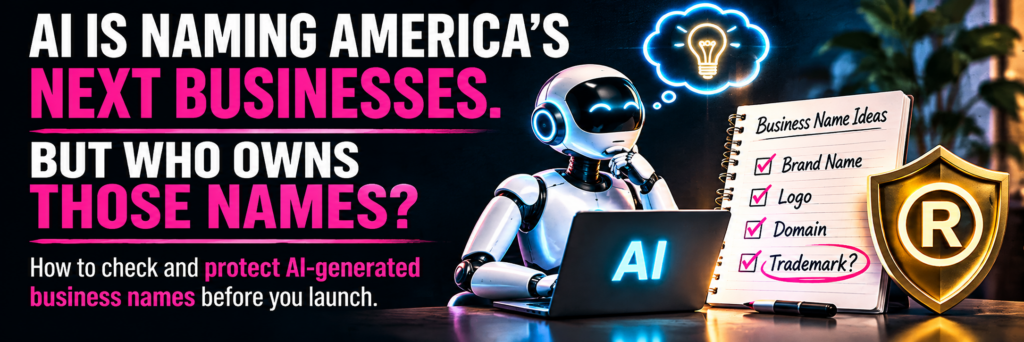

Not long ago, naming a new business meant brainstorming with friends, scribbling ideas on napkins, or spending thousands of dollars with a branding agency.
Today?
You open ChatGPT, type a few sentences, and within seconds you’ve got 50 potential business names, a catchy slogan, a logo concept, and maybe even a marketing strategy.
Welcome to entrepreneurship in the age of artificial intelligence.
It’s faster. It’s cheaper. And for millions of aspiring entrepreneurs, it’s opening doors that previously seemed closed.
But there’s a problem that many new business owners don’t realize until it’s too late.
Just because artificial intelligence creates a business name doesn’t mean you have the legal right to use it.
And that misunderstanding could become one of the most expensive mistakes of the AI entrepreneurship boom.
Artificial intelligence has fundamentally changed how entrepreneurs get started.
Need a name for a coffee shop? Ask AI.
Launching a clothing brand? AI can suggest dozens of names in seconds.
Developing a new app? AI can generate names, slogans, and branding concepts before you’ve finished your morning coffee.
For entrepreneurs working with limited budgets, these tools are extraordinary.
But AI-generated names aren’t necessarily unique.
AI systems generate suggestions based on patterns learned during training and the information provided in a prompt. Different entrepreneurs can receive similar suggestions, and a generated name may resemble a brand that’s already operating in the marketplace.
That means the perfect name suggested by your AI assistant might already be someone else’s trademark.
And unfortunately, “ChatGPT came up with it” isn’t a legal defense to trademark infringement.
Imagine this scenario.
An entrepreneur launches a new skincare company.
She uses AI to generate the business name, creates a beautiful logo, purchases a domain name, and begins selling products online.
The business takes off.
Six months later, she’s invested $10,000 in packaging, advertising, website development, and inventory.
Then comes the letter.
Another company claims her brand name infringes its existing trademark rights.
Suddenly, she may face a difficult choice: challenge the claim, negotiate a resolution, or rebrand the business she has spent months building.
And rebranding isn’t simply changing a logo.
It can mean replacing packaging, rebuilding a website, changing social media accounts, losing brand recognition, and explaining the change to customers.
Depending on the circumstances, there could also be legal expenses or liability.
The most expensive time to discover a trademark problem is after your business becomes successful.
This example is hypothetical, but the underlying risk is very real.
Here’s another misconception we encounter regularly at The Trademark Company.
An entrepreneur registers an LLC with the state and assumes the business name is protected.
Unfortunately, that’s not how trademark law works.
Registering an LLC generally establishes a legal business entity. It does not automatically grant nationwide trademark rights.
Likewise, purchasing a domain name doesn’t mean you own the corresponding trademark.
And creating an Instagram account or TikTok profile doesn’t establish that your business name is legally available.
Trademark rights in the United States generally arise from qualifying use of a mark in commerce. Federal registration can provide important additional protections, including a legal presumption of nationwide ownership and exclusive rights to use the registered mark for the goods or services identified in the registration, subject to applicable limitations.
Choosing a business name and protecting a business name are two very different things.
Here’s the good news.
Yes. A business name suggested by artificial intelligence can potentially qualify for trademark protection.
The important issue isn’t whether a human or an AI system came up with the name.
It’s whether the proposed mark meets the legal requirements for trademark protection.
Among other considerations, the name must function as a trademark, be sufficiently distinctive, and not create a likelihood of confusion with an existing mark.
For example, an invented name for a clothing company may be easier to protect than a generic term describing the clothing itself.
And a name that sounds completely original could still create problems if it is confusingly similar to an existing trademark used for related products or services.
This is why trademark searching and clearance are important before a new business commits significant resources to its brand.
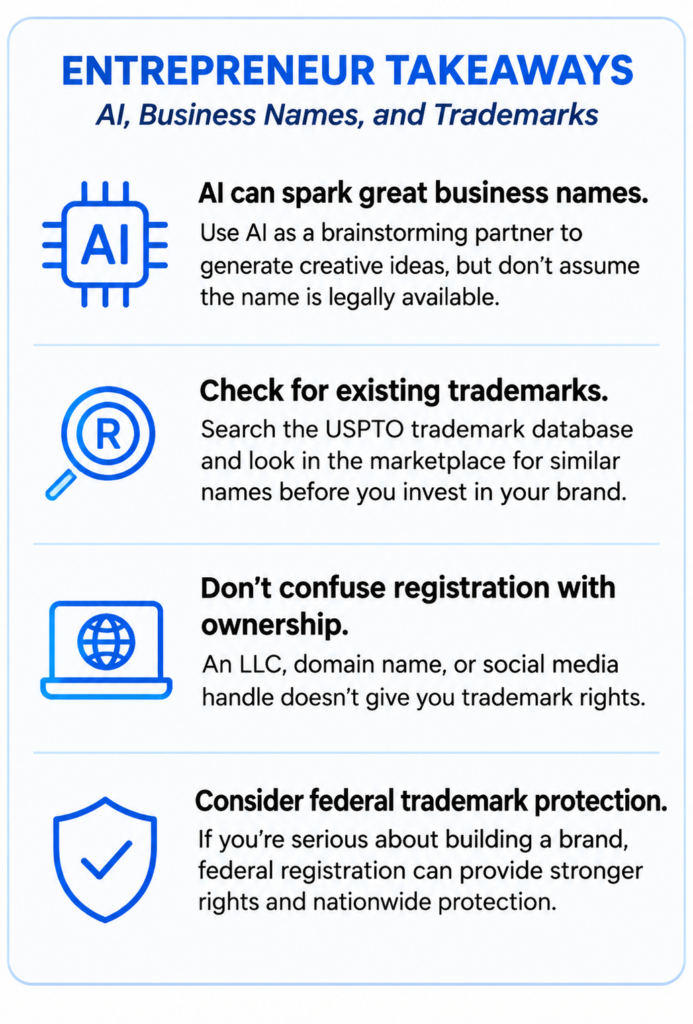
Artificial intelligence is a remarkable brainstorming partner. But before investing in a name it suggests, take a few additional steps.
| Before you launch… | Here’s what to do… |
|---|---|
| 1. Search existing trademarks. | Use the USPTO trademark search system. Look beyond identical names to similar spellings, sounds, and meanings. |
| 2. Search the marketplace. | Check Google, social media, online marketplaces, and industry directories. Businesses can have trademark rights without federal registration. |
| 3. Consider your products and services. | Similar names can create conflicts when customers are likely to believe the businesses or their products are connected. |
| 4. Don’t confuse availability with ownership. | An available LLC name, domain, or social media handle does not guarantee that a trademark is available. |
| 5. Consider federal registration. | Protect your brand as you build it. If you haven’t launched, an intent-to-use application may be an option, subject to USPTO requirements. |
We’re entering an extraordinary era for entrepreneurship.
A single individual can now accomplish tasks that once required an entire team.
AI can help write a business plan, design marketing materials, develop a website, and brainstorm a brand identity.
That’s genuinely exciting.
But here’s something technology hasn’t changed:
A successful business needs an identity that customers recognize, trust, and remember.
And that identity becomes more valuable as the business grows.
Your brand isn’t simply a clever name or an attractive logo.
It’s the reputation you build, the customers you serve, and the goodwill you create over time.
Artificial intelligence can help you invent that identity.
Protecting it requires a little more thought.
At The Trademark Company, we’ve spent more than two decades helping entrepreneurs and small businesses navigate trademark registration and protection.
We believe starting a business should be exciting—not an unnecessarily expensive legal guessing game.
If you’ve used AI to create a business name, or you’re preparing to launch a new product or company, take the time to investigate your proposed trademark before investing heavily in it.
Because the next great American business might begin with an AI prompt.
But building a brand worth owning is still up to you.
The Trademark Company helps entrepreneurs search, register, and protect their trademarks without the traditional complexity and expense.
Explore Our Trademark Registration Services →
Or call (800) 906-8626 to learn more.
This article is provided for general informational purposes and does not constitute legal advice. Trademark rights and registration eligibility depend on the specific circumstances.