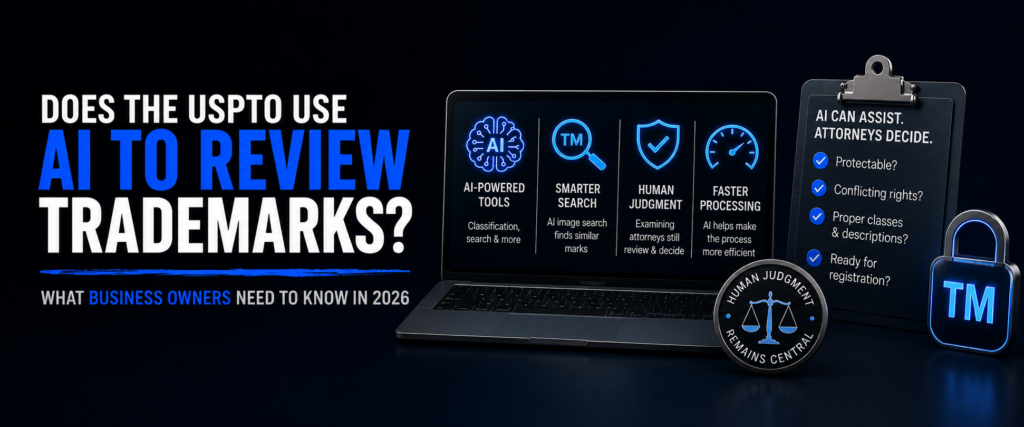

Yes. The United States Patent and Trademark Office (USPTO) now uses artificial intelligence in several parts of the trademark application, search, and examination process.
But AI does not decide whether your trademark gets approved.
Trademark examining attorneys remain responsible for substantive examination and applying trademark law.
For business owners, this distinction matters.
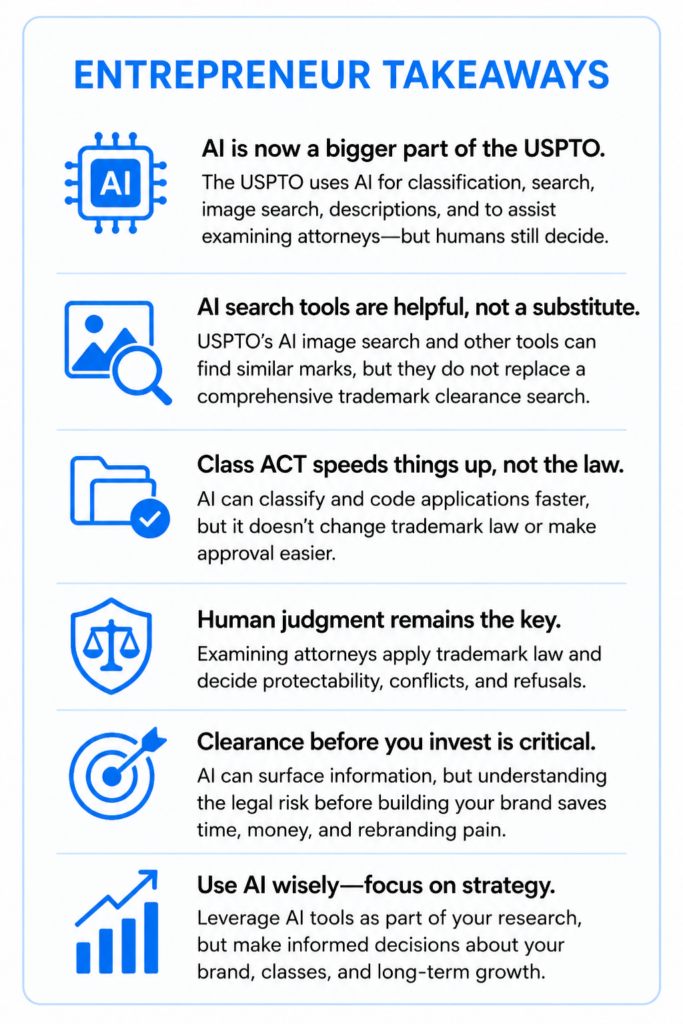
In 2026, the USPTO dramatically expanded its use of AI. New tools can classify trademark applications, identify design elements, help search for similar logos, generate proposed descriptions of marks and color claims, and assist USPTO personnel with research and drafting.
These changes could make parts of the federal trademark process faster and more efficient. They do not, however, eliminate one of the most important steps for anyone creating a new brand: determining whether a proposed trademark is actually available for use and registration.
Here is what business owners should know about how the USPTO is using AI—and what the technology can and cannot do.
Yes, although the role of AI requires some explanation.
On July 1, 2026, the USPTO’s Trademarks organization completed full adoption of Scout LLM, the agency’s enterprise artificial intelligence tool, extending access to all work units, including trademark examining attorneys.
According to the USPTO, Scout LLM can assist employees by summarizing information, analyzing data, researching topics, and drafting selectable content.
That does not mean an AI system has replaced trademark examining attorneys.
The USPTO describes its approach succinctly: examining attorneys lead, while AI tools support their work.
Trademark examining attorneys therefore continue to perform the substantive legal examination of applications.
For applicants, the practical takeaway is simple:
AI is becoming part of the trademark examination process, but human legal judgment remains central to whether a trademark application can proceed toward registration.
One of the biggest changes arrived earlier in 2026 with the introduction of the Trademark Classification Agentic Codification Tool, commonly called Class ACT.
Class ACT uses artificial intelligence to perform several tasks during the pre-examination processing of trademark applications.
The system can:
| AI Function | What It Does |
|---|---|
| Classification | Assigns International Classes to applications. |
| Design Coding | Identifies design search codes for logos and other design marks. |
| Pseudo Marks | Generates “pseudo marks” that help make certain trademarks searchable. |
These tasks are important because trademark applications involving designs, logos, unusual spellings, or incomplete classification information can be more difficult to categorize and search.
Historically, USPTO employees performed this coding work during application processing.
The USPTO announced in March 2026 that Class ACT could dramatically reduce the time needed for this stage of processing. The agency said classification preparation that previously could take months could potentially be completed within minutes. The USPTO also emphasized that the information generated by Class ACT continues to be reviewed by humans.
250,000
trademark applications analyzed by Class ACT by July 2026
For trademark applicants, the development could mean that applications become searchable and move through certain administrative stages more quickly.
It does not mean that the legal examination itself has disappeared.
Yes.
In April 2026, the USPTO introduced an AI-enabled image-search feature within its Trademark Search system.
Instead of attempting to describe every visual element of a logo, users can upload an image and ask the USPTO system to locate trademarks containing similar visual elements.
For entrepreneurs considering a new logo, this is potentially a very useful tool.
A business owner can log into a USPTO.gov account, select the image-search option, upload an image, and review potentially similar trademarks returned by the system.
However, there is an extremely important limitation.
No.
The USPTO specifically warns that its AI image-search feature is supplemental and does not replace a traditional trademark clearance search.
The agency also notes that searching through design search codes can produce different results, which is why multiple search methods may be appropriate.
This may be the most important point for business owners to understand about the USPTO’s new AI capabilities.
A trademark conflict is not necessarily limited to an identical name or identical logo.
The central question in many trademark disputes is whether consumers are likely to be confused about the source of the parties’ goods or services.
That analysis can involve similarities in:
As a result, searching only for an exact business name—or uploading a logo to an AI search engine—is not the same thing as conducting a comprehensive trademark clearance analysis.
AI is now heavily involved in classification, but business owners should distinguish between USPTO processing and choosing the correct filing strategy.
Federal trademarks are organized into International Classes covering different categories of goods and services.
A software company, restaurant, clothing brand, consulting business, and cosmetics company may each require different classifications. Some businesses need more than one class.
Class ACT can automatically assign classification information during USPTO pre-processing.
But an applicant still needs to accurately identify the goods and services for which trademark protection is being sought.
That decision can have significant consequences.
| Filing Issue | Potential Consequence |
|---|---|
| Description is too narrow | Important areas of the business may fall outside the scope of the registration. |
| Description is inaccurate | The application may encounter problems during examination. |
| Unnecessary classes are filed | Filing costs can increase. |
AI may make classification faster.
It does not necessarily determine the best trademark filing strategy for a particular business.
The USPTO is also using AI to help applicants prepare certain portions of trademark applications.
In 2026, Trademark Center introduced functionality that can generate a proposed description of a mark and color claim.
This can be helpful when an applicant is registering a logo or another design mark.
For example, a logo might contain stylized lettering, geometric shapes, colors, or other visual elements that need to be described as part of the application.
AI can assist with producing that description.
Applicants should still review anything generated by an automated system carefully before submitting it to the federal government.
The applicant remains responsible for the accuracy of the application.
Potentially—but don’t confuse faster processing with easier approval.
Some of the USPTO’s AI initiatives are specifically designed to reduce administrative delays.
Class ACT, for example, allows classification and coding information to be generated much earlier in the process, making applications searchable more quickly.
That could improve efficiency.
But AI cannot eliminate the substantive legal issues that commonly cause trademark applications to encounter problems.
An examining attorney may still refuse registration because, among other reasons, a proposed trademark is:
In other words:
AI may help the USPTO process information faster. It does not change the underlying requirements for federal trademark registration.
Not reliably by itself.
This is where business owners should be particularly cautious.
AI tools are extremely good at finding and organizing information. But determining whether a trademark presents a meaningful legal risk can require more than finding identical words.
Consider a hypothetical entrepreneur who wants to launch a company called:
BLUE FOX COFFEE
A search revealing no identical federal registration for BLUE FOX COFFEE would not necessarily mean the name is clear.
Potentially relevant marks could use:
| BLUE FOX | BLU FOX |
| BLUEFOX | BLUE FOX CAFÉ |
| FOX BLUE | A similar-sounding variation |
| A logo creating a similar commercial impression | |
Whether any particular mark creates a problem depends on both the similarities between the trademarks and the relationship between the relevant goods and services.
An AI search can help identify candidates.
Determining what those results mean is a different question.
Possibly.
There is an interesting consequence of the USPTO becoming better at organizing and searching trademark data.
If AI makes similar trademarks easier for examining attorneys to discover, applicants may have even more reason to conduct meaningful clearance work before filing.
The worst time for a business owner to discover a trademark problem is after investing heavily in the brand.
Imagine launching a company and then spending money on:
| Domain name | Website development |
| Packaging | Signs |
| Advertising | Social-media accounts |
| Product inventory | Customer acquisition |
If a significant trademark conflict emerges afterward, changing the brand can be far more expensive than investigating the name before launch.
That principle existed long before artificial intelligence.
AI simply gives both applicants and the USPTO increasingly sophisticated tools for finding potentially conflicting marks.
AI can be useful as one component of trademark research.
Business owners can use modern search tools to brainstorm possible conflicts, investigate USPTO records, explore variations of a proposed name, and identify visually similar logos.
But AI output should not automatically be treated as a legal conclusion.
There is an important difference between these two statements:
“The search did not find an identical trademark.”
and
“The trademark appears sufficiently clear to use and seek federal registration.”
The first is a search result.
The second involves analysis.
That distinction becomes particularly important when a business is about to invest significant money in a new name, product, service, or brand.
No.
Despite the USPTO’s significant adoption of artificial intelligence in 2026, trademark examining attorneys remain responsible for substantive examination.
AI assists with functions including classification, coding, searching, research, summarization, and drafting support.
Human examining attorneys continue to apply trademark law to individual applications.
So while the technology behind the trademark system is changing rapidly, the fundamental questions facing an applicant remain familiar:
Is the trademark protectable?
Does someone else already have conflicting rights?
Are the goods and services properly identified?
Is the application prepared correctly?
And ultimately:
Is this a brand the business can safely invest in?
The USPTO’s new AI tools can make trademark information easier to find, but technology does not eliminate the value of doing the work correctly before an application is filed.
Before committing significant resources to a new trademark, business owners should generally:
| # | Step | Why It Matters |
|---|---|---|
| 1 | Identify the trademark | Determine whether protection is being sought for a business name, product name, slogan, logo, or combination of these elements. |
| 2 | Search beyond exact matches | Look for identical and similar trademarks, including spelling variations, phonetic equivalents, related wording, and potentially similar commercial impressions. |
| 3 | Consider the goods and services | Similar trademarks can present very different risks depending on what each business sells. |
| 4 | Investigate logo conflicts | The USPTO’s AI image search can help, but the USPTO says it should not replace traditional clearance searching. |
| 5 | Choose filing basis, classes, and descriptions | These decisions determine what the application actually seeks to protect. |
| 6 | Review the application carefully | AI-generated classifications or descriptions should be treated as tools—not substitutes for verifying the application’s accuracy. |
Yes. In 2026, the USPTO expanded the use of AI throughout its Trademarks organization. Its tools now assist with functions including classification, design coding, image searching, research, summarization, and drafting.
No. Trademark examining attorneys remain responsible for substantive examination. AI tools assist USPTO personnel but do not replace their legal judgment.
Class ACT stands for Trademark Classification Agentic Codification Tool. It uses AI to assign International Classes, identify design search codes, and generate pseudo marks during application pre-processing.
Yes. The USPTO introduced an AI-enabled image-search feature in 2026 that allows logged-in users to upload an image and search the federal trademark database for visually similar marks.
No. The USPTO expressly states that AI image searching is supplemental and does not replace traditional trademark clearance searching.
AI can assist with trademark searching and identifying potentially similar marks. However, evaluating whether those marks create a likelihood-of-confusion problem involves legal analysis that goes beyond simply finding identical search results.
AI can make trademark information easier to search and applications easier to process, but it does not eliminate questions about clearance, likelihood of confusion, filing strategy, classification, or responses to USPTO refusals. For a business investing substantial resources in a brand, those issues can be considerably more important than completing the application form itself.
Artificial intelligence is changing how the USPTO processes and searches trademark applications.
In 2026, the agency introduced AI-powered classification through Class ACT, AI-assisted image searching for logos, automated assistance for mark descriptions and color claims, and broader AI tools for USPTO personnel—including examining attorneys.
Those developments could make the federal trademark system faster and easier to navigate.
But they do not change the most important question a business owner should answer before building a brand:
Can I safely use and protect this trademark?
AI can help find information.
The value of a comprehensive trademark search is understanding what that information means before you invest in the brand.
For business owners preparing to launch a company, product, or service, conducting appropriate trademark clearance before filing—and ideally before making a major investment in the name—remains one of the most important steps in protecting the value of the brand.