At 8:17 on a Tuesday morning, David’s phone buzzed with an email he almost ignored. The subject line read: Trademark Infringement – Immediate Attention Required.
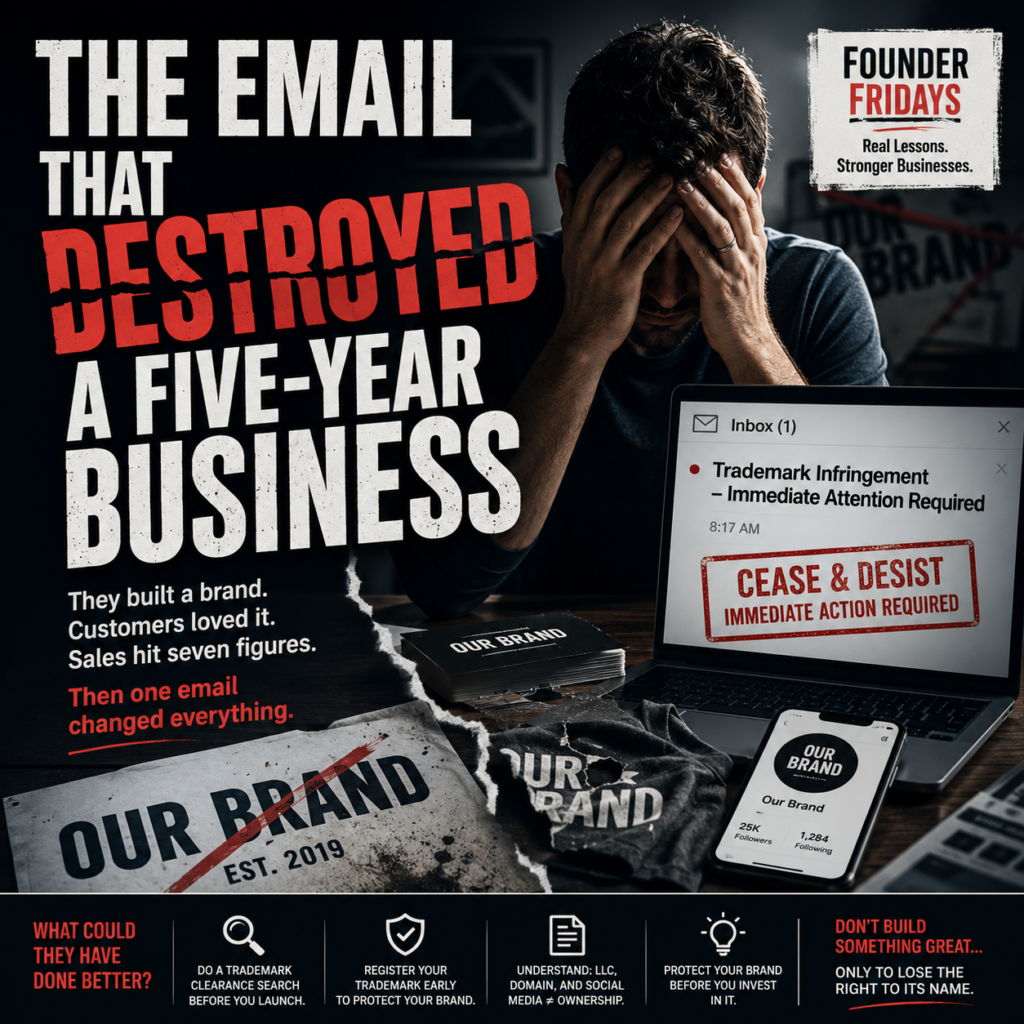
He assumed it was spam, but curiosity got the better of him. By the time he finished reading the first page, his coffee had gone cold. Twenty minutes later, he was on the phone with his wife. By lunchtime, they were asking a question neither of them had ever imagined: Could we actually lose the business we’ve spent the last five years building?
Five years earlier, David had walked away from a comfortable corporate job with a dream of building something his family could be proud of. Like most entrepreneurs, he spent weeks brainstorming the perfect business name. When they finally landed on one, everything seemed to fall into place. The domain name was available. The LLC could be registered with the state. The social media handles were open. Friends loved the name, customers remembered it, and it felt like the perfect foundation for the company they envisioned.
They filed the LLC, purchased the domain name, built a website, printed business cards, wrapped their company truck, embroidered uniforms, installed a storefront sign, and opened their doors. Business was slow at first, but with persistence it grew. One satisfied customer led to another. Positive reviews accumulated. Referrals increased. Five years later, the company employed a dozen people, generated more than a million dollars in annual revenue, ranked on the first page of Google for several important searches, and had built a loyal following across social media. They had invested well over $200,000 into marketing, advertising, signage, branding, and customer acquisition. Their business name had become one of their most valuable assets—or so they believed.
The email changed everything.
An attorney representing another company claimed ownership of a federally registered trademark for a confusingly similar name used in connection with related services. The letter demanded that David immediately stop using his company’s name, remove it from his website, social media accounts, advertising, signage, and marketing materials, and confirm compliance within fourteen days.
David was stunned. “There has to be some mistake,” he said. “We formed the LLC years ago.”
His attorney explained something that countless entrepreneurs never realize until it’s too late: registering an LLC does not automatically give you trademark rights to a business name. State business registrations and trademark rights serve different purposes. A state may allow multiple businesses with similar names because its job is to register legal entities—not determine whether those names infringe someone else’s trademark rights.
“But we own the domain name,” David replied.
Owning a domain name simply means you have the right to use that internet address. It does not necessarily give you exclusive legal rights to use the words in that domain as a brand.
“We’ve been using the name for five years.”
Length of use can matter in trademark law, but it doesn’t automatically override another party’s rights. Every trademark dispute depends on its specific facts, including who used the mark first, where it was used, how it was used, and whether consumers are likely to be confused.
“But nobody ever contacted us before.”
Sometimes these conflicts aren’t discovered until years later. A trademark owner may not become aware of another business until it expands geographically, invests heavily in advertising, gains media attention, or begins appearing prominently in online search results.
Suddenly, everything David believed protected his business wasn’t enough.
Over the next several weeks, the consequences became painfully real. The storefront sign had to come down. The truck wrap had to be replaced. Thousands of business cards and printed brochures became worthless. The website required a complete redesign. Every social media profile had to be renamed. Online business listings had to be updated one by one. Customers became confused. Some wondered if the company had been sold. Others assumed it had gone out of business altogether. Search engine rankings built over years began to disappear as the old brand was replaced with a new one. Years of goodwill had to be rebuilt almost from scratch.
The financial cost of the rebrand was significant. The emotional cost was even greater.
The most painful realization wasn’t replacing signs or redesigning a website. It was understanding that years of hard-earned brand recognition couldn’t simply be transferred to a new name overnight.
The heartbreaking part is that much of this risk could have been reduced before the business ever opened its doors.
Many entrepreneurs assume that if they can register an LLC, purchase a domain name, and secure social media usernames, they’re protected. Unfortunately, those steps answer entirely different questions. An LLC registration tells you whether your state will register your business entity under that name. A domain registrar tells you whether an internet address is available. A social media platform tells you whether a username has already been claimed. None of those steps, by themselves, determine whether someone else may already have trademark rights that could affect your ability to use that name as your brand.
That’s why one of the smartest investments a founder can make occurs before spending significant money on logos, signs, advertising, packaging, or marketing.
It starts with conducting a thoughtful trademark clearance search.
A proper clearance process goes far beyond typing a name into Google. It includes reviewing federal trademark registrations, considering state trademark records where appropriate, searching for businesses that may have established rights through use even without a federal registration, evaluating confusingly similar names—not just identical ones—and assessing whether the proposed name is distinctive enough to function as a strong, protectable brand.
If the results suggest the name is available, filing for federal trademark registration early can help strengthen your legal position as your business grows.
No clearance search can guarantee that a dispute will never arise. Trademark law is fact-specific, and every situation is different. But performing appropriate due diligence before investing heavily in a brand can dramatically reduce the likelihood of discovering a costly problem years down the road.
Think about it this way. Few people would buy a house without first confirming who owns the property. Yet entrepreneurs routinely invest years of their lives and hundreds of thousands of dollars building businesses around names they’ve never properly investigated. They carefully research software, office space, equipment, suppliers, payroll providers, and insurance policies, but many spend less time researching the very name that customers will remember long after they’ve forgotten everything else.
Over time, your brand becomes much more than a logo. It becomes your reputation. Customers search for it online. They recommend it to friends. They associate it with every experience they’ve had with your company. In many businesses, the brand eventually becomes one of the most valuable assets the company owns.
Protecting that asset shouldn’t be an afterthought.
It should be one of the very first strategic decisions you make.
The lesson from David’s story isn’t that entrepreneurs should be afraid of starting businesses. It’s that they should build those businesses on a solid foundation. Choose your name carefully. Understand the difference between an LLC, a domain name, and trademark rights. Conduct appropriate trademark clearance before investing heavily in branding and marketing. Then, once you’ve confirmed you’re building on solid ground, invest confidently in growing a brand you can truly call your own.
The most expensive mistake a founder can make isn’t choosing the wrong logo or printing the wrong business cards.
It’s spending five years building a brand without first asking whether they had the right to build it.
Question for founders: If you were starting your business today, what step would you never skip before investing your first major marketing dollar?
If you’re building a business that’s meant to last, don’t wait until confusion becomes a costly problem. Learn your options, understand your risks, and take proactive steps to strengthen your brand. The Trademark Company has helped more than 100,000 entrepreneurs protect the businesses they’ve worked so hard to build, and we’re ready to help you do the same.